Ask any fund manager, M&A advisor, or family office principal how many software tools their team uses to manage a single deal from first contact to signed term sheet and the answer is almost always the same: too many, and none of them properly connected.
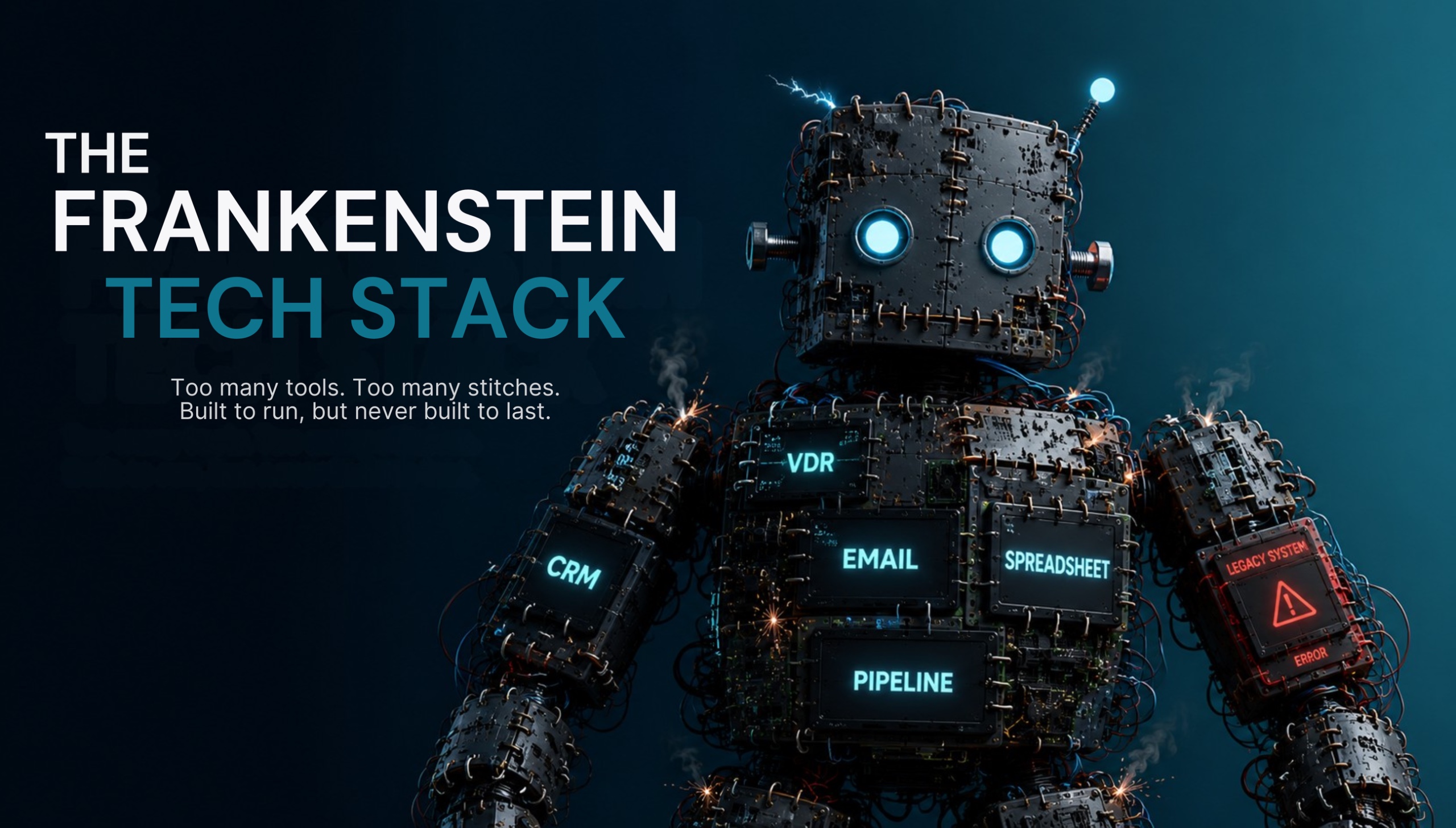 |
A CRM in one place. A virtual data room from a different vendor. Deal notes in email threads. Investor communications in a spreadsheet. Pipeline stages tracked in a tool nobody else on the team fully understands. This is the Frankenstein tech stack and for investment firms managing live deal flow, it is not just an inconvenience. It is a direct drag on deal velocity, investor relationships, and competitive positioning.
"Every disconnected tool in your deal workflow is a place where momentum goes to die."
How the fragmented deal stack is built
No investment team deliberately builds a fragmented workflow. It accumulates. A firm adopts a general-purpose CRM because it is what the sales team already uses. They subscribe to a standalone VDR for a live transaction because it seemed fastest at the time. Investor updates go out via email because the CRM cannot handle deal-room collaboration. A spreadsheet becomes the unofficial pipeline tracker because no single platform holds the full picture.
Each decision was rational in isolation. The cumulative result is a deal workflow that requires constant manual stitching: between platforms, between formats, between team members who each hold a different piece of the picture. As deal volume grows, the fragmentation compounds. What was manageable at five active deals becomes a genuine operational liability at fifteen.
The hidden costs of fragmented deal management
1. Deals lost to slow response times
Institutional deal flow moves on speed and relationship quality. When your team has to jump between a CRM, a separate VDR, and an email thread to find the latest status on a live opportunity, response times suffer. Counterparties: whether investors, acquirers, or deal providers: notice. In competitive mandates, being second to respond is functionally the same as not responding at all. Fragmented tools cost you deals without ever appearing on a loss analysis.
2. Investor relationships managed in silos
Investment CRM is not a general-purpose contact database: it requires deal-level context, interaction history, interest mapping, and document access all visible in one place. When investor relationships are managed across disconnected tools, relationship intelligence gets lost between systems. You send the wrong opportunity to the wrong investor. You miss a follow-up because it was logged in the wrong place. Over time, the quality of your investor coverage degrades silently.
3. VDR chaos undermines deal credibility
A virtual data room is not just a file repository: it is a signal of how professionally a firm manages its processes. When document versions are inconsistent, access permissions are poorly controlled, or counterparties receive the wrong materials, it erodes trust at precisely the moment trust matters most. Standalone VDR tools that are not connected to your deal workflow create exactly these gaps, especially under the time pressure of active fundraising or M&A execution.
4. Fundraising campaigns without pipeline visibility
Running a fundraising or sales campaign across multiple tools means your team never has a live view of where each investor sits in the process. Interest signals get missed. Follow-up timing is based on memory rather than data. Warm introductions fall through gaps between platforms. An integrated fundraising workflow: where deal rooms, investor portals, and pipeline stages are connected: turns a scattered outreach effort into a managed, repeatable process.
5. Key-person dependency baked into the workflow
When your deal process relies on three different tools held together by one person who knows how they connect, you do not have a workflow: you have a dependency. Every addition to the team requires weeks of onboarding into a system of workarounds. Every departure creates an operational gap. The more fragmented the stack, the more institutional knowledge lives in individuals rather than in the platform itself.
Warning signs your deal workflow is already fragmented
• Your team uses more than two tools to manage a single deal from origination to close.
• Investor pipeline status lives in a spreadsheet that is updated manually after every interaction.
• A new team member takes weeks to understand which system holds which information.
• Document version control in your VDR is managed by email rather than permissions.
• You have lost track of an investor’s interest level because the follow-up was logged in the wrong place.
• Fundraising campaign performance cannot be reported without pulling data from multiple sources.
• When a senior team member is unavailable, deal momentum stalls because only they know the full picture.
What a unified deal management platform actually changes
The shift from a fragmented stack to a single, end-to-end deal management platform is not just an operational improvement: it changes the quality of decisions your team can make and the speed at which they can act.
When investment CRM, deal management, virtual data room, investor portal, and fundraising campaign tools are built into one connected platform, the compounding effect is significant. Your CRM knows which investors have accessed which documents in the VDR. Your deal pipeline reflects live investor interest signals, not manually updated status fields. Your fundraising campaign runs from the same system that holds your investor relationships: so nothing falls through the gaps between platforms.
AI-assisted deal workflows take this further. When an AI agent can surface relevant investor matches, track document engagement, and assist in moving deals through pipeline stages: all within the same platform: the operational advantage over firms still stitching together disconnected tools becomes a genuine competitive moat. Not in theory. In deal outcomes.
FAQs
The following questions reflect what investment professionals most commonly search for when evaluating deal management and investment platform solutions.
What is an all-in-one investment management platform?
An all-in-one investment management platform combines deal flow management, investor CRM, virtual data room (VDR), fundraising tools, and investor portal access into a single connected system — eliminating the need for multiple disconnected software subscriptions and the manual work required to keep them synchronised.
How does a deal flow management platform improve fundraising?
A connected deal flow platform gives fundraising teams live visibility into investor engagement — including document access, interest signals, and pipeline stage — so follow-up is timely, targeted, and based on data rather than memory. This reduces the time from first investor contact to commitment and improves campaign conversion rates.
What should fund managers look for in a VDR solution?
Fund managers should prioritise a VDR that is natively integrated with their deal management and investor CRM workflows, rather than a standalone product. Integration ensures document access is tracked against investor relationships, permissions are controlled at the deal level, and audit trails are automatically maintained without manual administration.
Why do investment firms switch from multiple tools to a single platform?
The primary drivers are deal velocity, investor relationship quality, and team scalability. Fragmented tools require constant manual synchronisation, create information silos, and generate key-person dependencies that limit growth. A unified platform removes these frictions and allows the firm to scale deal volume without proportionally scaling administrative overhead.
What is a reverse inquiry model in investment platforms?
A reverse inquiry model allows deal providers — startups, secondary sellers, and companies seeking capital — to be discoverable to investors actively searching for opportunities, rather than relying solely on direct outreach. This creates a two-sided marketplace dynamic that increases deal origination efficiency for both sides.
The Verdict
The Frankenstein tech stack in investment management is not a technology problem: it is a prioritisation problem. When every quarter is measured by deal count and mandate wins, nobody pauses to ask whether the tools holding the workflow together are actually built for the job.
The cost accumulates quietly: in deals that moved slower than they should have, in investor relationships that did not receive the follow-up they deserved, in fundraising campaigns that underperformed because the pipeline was invisible, and in team members who carried too much in their heads and not enough in a system.
A purpose-built, end-to-end deal management platform does not just solve these problems it compounds the advantage of solving them. Faster deal execution, stronger investor relationships, and a scalable operational foundation that grows with the business rather than against it.
The question is not whether your firm needs a better deal platform. The question is how many opportunities have already been shaped by the limitations of the one you have.